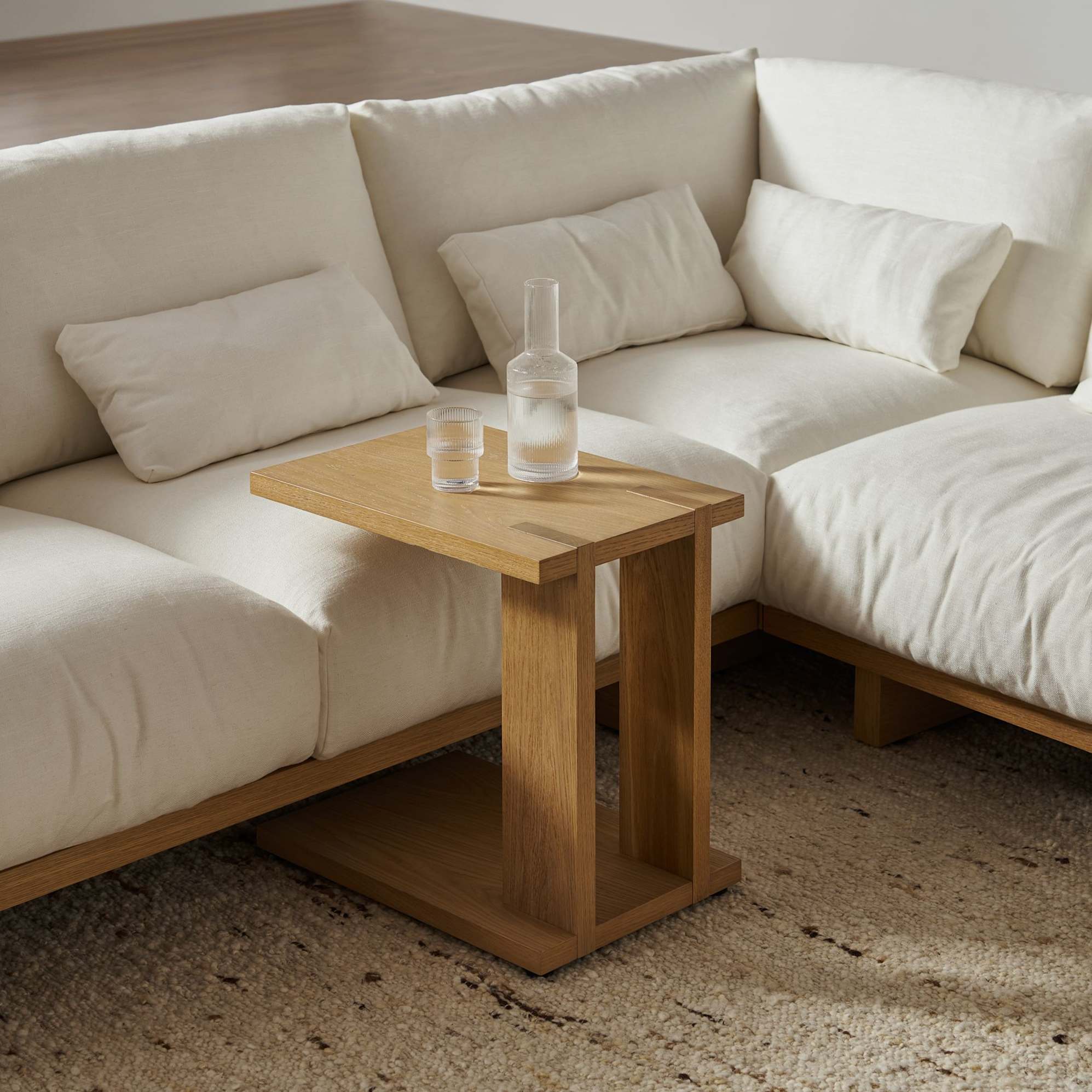
How to Make Japandi Design Work in A Small Apartment
Somewhere on your Pinterest board is a Japandi living room with three pieces of furniture, one plant, and absolutely no evidence that anyone actually lives there.
Then you look at your own apartment, where the same few hundred square feet has to hold your books, coats, chargers, and the vacuum you have nowhere to hide.
The gap between that picture and your apartment isn't taste. It's storage.
If you're wondering how to decorate a small apartment Japandi style, you don't necessarily need less. You need furniture that works harder, storage that keeps clutter out of sight, and a layout that leaves room to breathe. Because a small home can still feel like a getaway. It just needs to work a little smarter behind the scenes.
Can Japandi actually work in a small apartment?
Short answer: yes. The principles behind Japandi interior design make a natural fit for smaller homes. Japandi blends Japanese minimalism with Scandinavian hygge. Clean lines and function from one side, warmth and comfort from the other. Both traditions grew out of small living.
Japanese homes were designed around compact footprints and multi-purpose rooms, whereas Scandinavian design was built for long, indoor winters. Neither needed square footage to feel complete. They needed intention, which is exactly what a small apartment already asks of you.
It isn't a workaround for a small space. It's a system that was built for one.
Start with the materials, not the square footage
Start with natural Japandi materials, particularly wood with a visible grain. Oak, ash, and acacia can bring depth without making a compact room feel visually heavy. Pair those warmer elements with shades of sand, oatmeal, beige, warm white and soft clay rather than relying entirely on stark white or cool grey.
Then layer in texture. A bouclé sofa, linen cushions, a wool throw, or a textured rug can make a relatively simple room feel considered and comfortable. You don't need a dozen decorative objects to create personality when the materials themselves are doing some of the work.
The goal is a room that feels quiet and tactile, rather than empty.
The Harper Dining Table
Picture credits: @our_place_gs
The Harper Dining Table
Picture credits: @our_place_gs

The Seb L-shaped Desk
Picture credits: @ashtyn_bodensteiner
The Seb L-shaped Desk
Picture credits: @ashtyn_bodensteiner

Make storage the foundation of your Japandi small space
Here's the part those immaculate inspiration photos tend to skip: your stuff still exists after the photographer leaves.
That's why Japandi storage ideas should come before styling.
Clutter is rarely just a matter of having too many things. More often, it's a matter of those things not having a designated home. When everything lands on the dining table, sofa or kitchen counter, even a beautifully designed apartment starts to feel chaotic.
The answer is to build storage into the room rather than treating it as an afterthought.
Choose furniture that hides what you don't want to see
Closed storage is particularly useful in a small Japandi home because it keeps everyday clutter out of sight without adding visual noise.
A low sideboard can hold tableware, paperwork, or electronics while giving you a clean surface above. A narrow cabinet can take advantage of vertical space without consuming much floor area.
And when choosing between open shelving and closed storage, ask yourself an honest question: do you actually want to style that shelf every week?
Let your sofa do more than provide a place to sit
In a small Japandi living room layout, the sofa is usually the largest piece in the room, so it needs to earn its footprint. Look for smaller profiles with clean silhouettes rather than oversized arms or bulky bases. Better still, consider a sofa with built-in storage where the design allows it.
This is particularly useful when your living room also needs to accommodate blankets, books, or the general collection of things that somehow migrate into the living room.
The Agnes Slipcover Storage Sofa
Picture credits: @daysofahomebody
The Agnes Slipcover Storage Sofa
Picture credits: @daysofahomebody

The Mori Performance Fabric Chaise Sectional Couch
Picture credits: @lifew.erin
The Mori Performance Fabric Chaise Sectional Couch
Picture credits: @lifew.erin

Give awkward spaces a purpose
A Japandi-style small space rewards you for looking beyond the obvious places. Tall, narrow cabinets can make use of vertical space without taking over the floor. Slim consoles can occupy otherwise wasted wall space. Storage beds can keep bulky or seasonal belongings tucked away without adding another cabinet to your room.
You aren't trying to squeeze furniture into every available corner. You're looking for the spaces that can work harder without making the room feel busier.
Give everyday clutter a home
Keys, mail, chargers, and remote controls don't disappear just because your interior is minimalist. Give them somewhere to go—like a cabinet near the entryway for keys and small essentials, a sideboard for paperwork and electronics, and a tray to corral the few objects you use every day.
Because clutter isn't a personality flaw, sometimes it's just a missing drawer.
Build a Japandi small living room layout around breathing room
A small living room layout doesn't need to feel cramped, but the layout needs to leave room for movement.
Start with your largest piece, usually the sofa, and position it against the longest practical wall. From there, build the rest of the living room arrangement around how you actually move through the room.
Avoid pushing every piece against a wall simply because the room is small. That can leave you with an awkward pocket of unused floor in the center while making the seating arrangement feel disconnected.
Instead, think about creating one cohesive zone.
A compact sofa paired with one occasional chair can often work better than trying to squeeze in multiple full-sized seats. A small coffee table can anchor the arrangement without becoming an obstacle course. And if you need flexibility, modular seating gives you more ways to adapt the room as your needs change.
Then protect your pathways. You should be able to walk through the room without performing the familiar small-apartment shuffle around a coffee table.
Use one rug to make the room feel bigger
A rug can help visually gather your seating into one defined area, which is particularly useful when you're working with an open-plan apartment.
Rather than scattering several small rugs around the room, use a rug to anchor the main seating arrangement. It creates a visual boundary without adding another physical one.
That's especially useful for a small living room layout, where the goal is to create definition without making the room feel chopped up.
Choose smaller profiles, not smaller comfort
There's a difference between compact furniture and uncomfortable furniture.
You shouldn't have to sacrifice a proper place to stretch out just because you live in a small apartment. Instead, pay closer attention to proportions.
Look for sofas with slimmer arms, streamlined bases, and a depth that suits your room. Choose dining tables with a smaller footprint that leaves enough clearance for chairs. Consider nesting tables or movable pieces when you need surfaces that can appear when required and disappear when they're not.
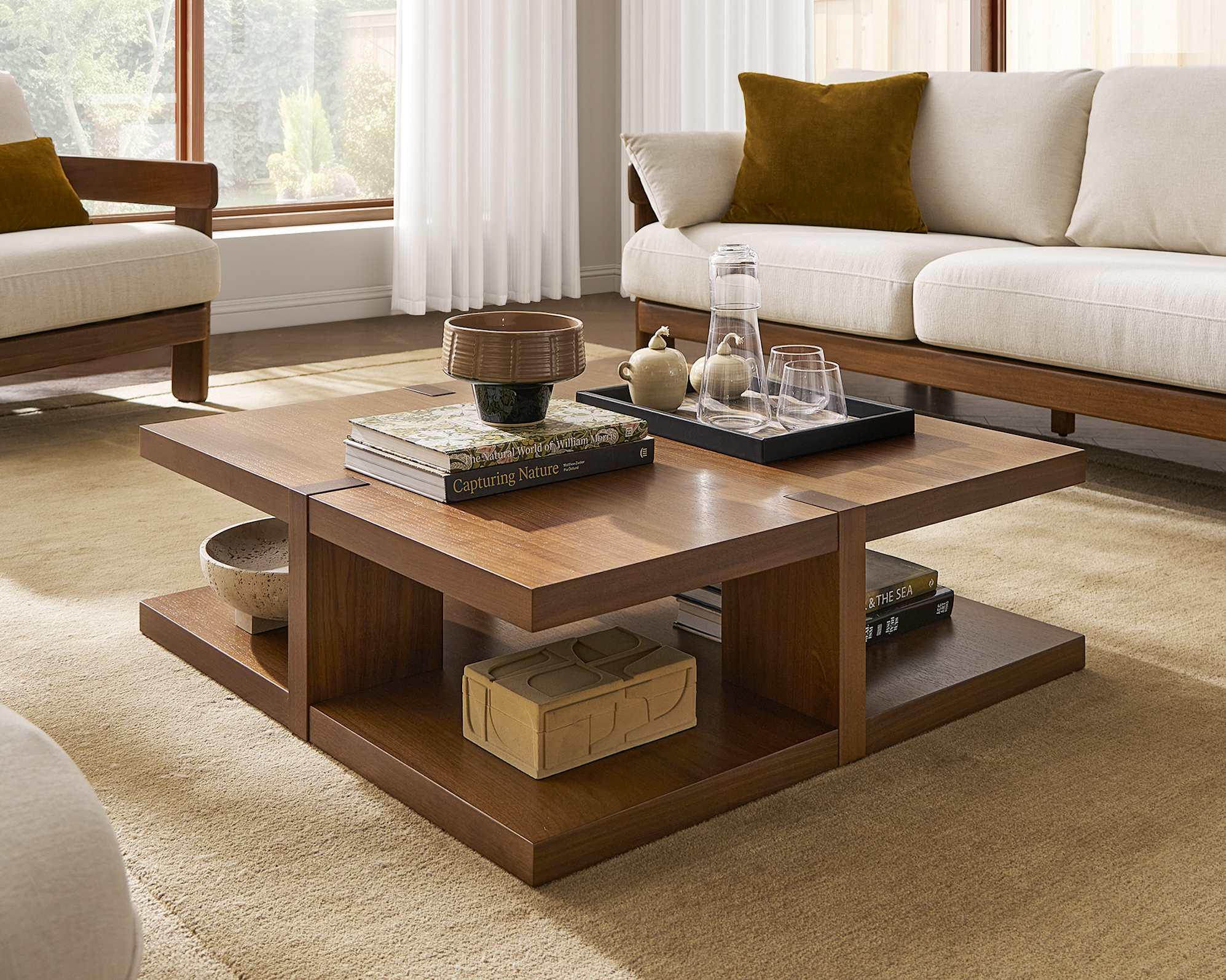
The Hugg Nesting Rectangular Coffee Table
Picture credits: @homewithtohs
The Hugg Nesting Rectangular Coffee Table
Picture credits: @homewithtohs


Small footprint, big getaway feeling
A small apartment doesn't need less personality, comfort, or design. It needs furniture and storage that work harder behind the scenes.
So, can Japandi work in a small apartment? Absolutely, when you treat storage as part of the design rather than something to solve afterwards.
The result shouldn't feel like you've squeezed a Japandi mood board into a tiny footprint. It should feel like your own little retreat: calm when you need it, practical when life gets messy, and warm enough to make coming home feel like getting away.
Frequently asked questions about Japandi materials
What makes Japandi style?
Japandi comes from combining Scandinavian functionality with Japanese minimalism, specifically the wabi-sabi philosophy of finding beauty in imperfection. It shows up as a restrained material palette: pale to mid-toned wood, natural fibers like linen and cotton, stone and ceramics chosen for texture rather than polish. The furniture tends toward clean lines and a low profile, a nod to traditional Japanese seating.
Are wabi-sabi and Japandi the same?
No. Wabi-sabi is a Japanese philosophy about finding beauty in imperfection, asymmetry and the visible signs of age. Japandi is an interior design style that borrows wabi-sabi as one of its two main influences, alongside Scandinavian design. Think of wabi-sabi as one ingredient in Japandi, not the whole recipe.
How does Japandi interiors differ from Scandinavian
Scandinavian design leans toward brightness, symmetry and a fairly uniform light wood palette. Japandi pulls in a bit more weight and depth, borrowing from the darker, more considered tone of traditional Japanese interiors and layering in materials that are allowed to show wear. The result reads warmer and slightly more grounded than pure Scandinavian minimalism, without losing the simplicity that made Scandi popular in the first place.
