
Balancing Straight and Curved Lines in Interior Design
Some rooms feel sharp before you can say why. The walls meet at clean angles, the sofa holds a rigid silhouette, and the coffee table has corners you’ve already bruised a shin on. Nothing’s technically wrong; the room just has the warmth of a waiting room.
The fix usually isn't buying more furniture. It's understanding geometry.
Every room is built from lines, and those lines quietly influence how a space feels, whether it comes across as calm, energetic, structured, or inviting. Curved lines in interior design often steal the spotlight because they're softer and more organic, but they're only one part of the story.
The most comfortable homes rely on the relationship between straight and curved lines, not one or the other. The goal isn't to choose sides; It's to find balance.
Why lines in interior design matter more than you think
Before colour, texture, or décor enters the conversation, every room starts with lines.
Lines in interior design create the visual framework that guides your eye through a space. They establish rhythm, define movement, and influence how large, open, or relaxed a room feels. Think of them as the skeleton beneath every beautifully styled home. You might not consciously notice them, but you'll certainly notice when they're out of balance.
Mixing different interior design lines creates visual tension in all the right ways, giving your home personality without making it feel chaotic.
The Forma Round Dining Table
Picture credits: @tam.weller
The Forma Round Dining Table
Picture credits: @tam.weller
The Sloane Travertine Dining Table
Picture credits: @stevecordony
The Sloane Travertine Dining Table
Picture credits: @stevecordony
The three main lines that shape every room
Horizontal lines create calm
Horizontal lines in interior design naturally feel stable and restful. They're found in low-profile sofas, long media consoles, floating shelves, and expansive dining tables. Because they stretch across a room rather than upwards, they encourage your eyes to slow down, making spaces feel wider and more grounded.
If you're designing a room that's meant for unwinding, horizontal lines quietly do much of the heavy lifting.
Vertical lines add energy and height
Where horizontal lines settle a room, vertical lines in interior design do the opposite. They pull the eye upward, making ceilings appear taller and spaces feel more spacious.
Tall bookcases, floor lamps, full-height curtains, and slim cabinets all create this effect. They're particularly useful in compact homes where every visual trick helps create the feeling of breathing room.
Curved lines soften and connect
Curved lines in interior design introduce movement where straight lines create order. Unlike rigid edges that stop your gaze, curved shapes gently guide your eyes around a room. That's partly why rounded furniture often feels so welcoming. It echoes the forms we naturally encounter outdoors, from rolling hills to winding rivers, making interiors feel less mechanical and more lived in.
The key isn't replacing straight lines with curves. It's allowing curved shapes to soften a room that's already grounded by structure.
Why contrast creates better balance in interior design
Most homes already have plenty of straight lines. Walls, windows, floorboards, ceilings, kitchen cabinetry, and door frames all establish a naturally linear foundation. That's a good thing because it creates stability.
Curves earn their place through contrast.
An arched mirror feels striking because it's surrounded by rectangular walls. A round coffee table catches your attention because everything around it is angular. Without those straight lines, curves lose much of their impact.
Lean too heavily in either direction, and the room begins to feel one-dimensional. An entirely linear room can feel overly formal, while a room filled with nothing but curves risks feeling whimsical without enough structure to anchor it.
Good balance in interior design comes from allowing one geometry to lead while the other provides relief.

The Hamilton Round Chaise Sectional Sofa
Picture credits: @stevecordony
The Hamilton Round Chaise Sectional Sofa
Picture credits: @stevecordony
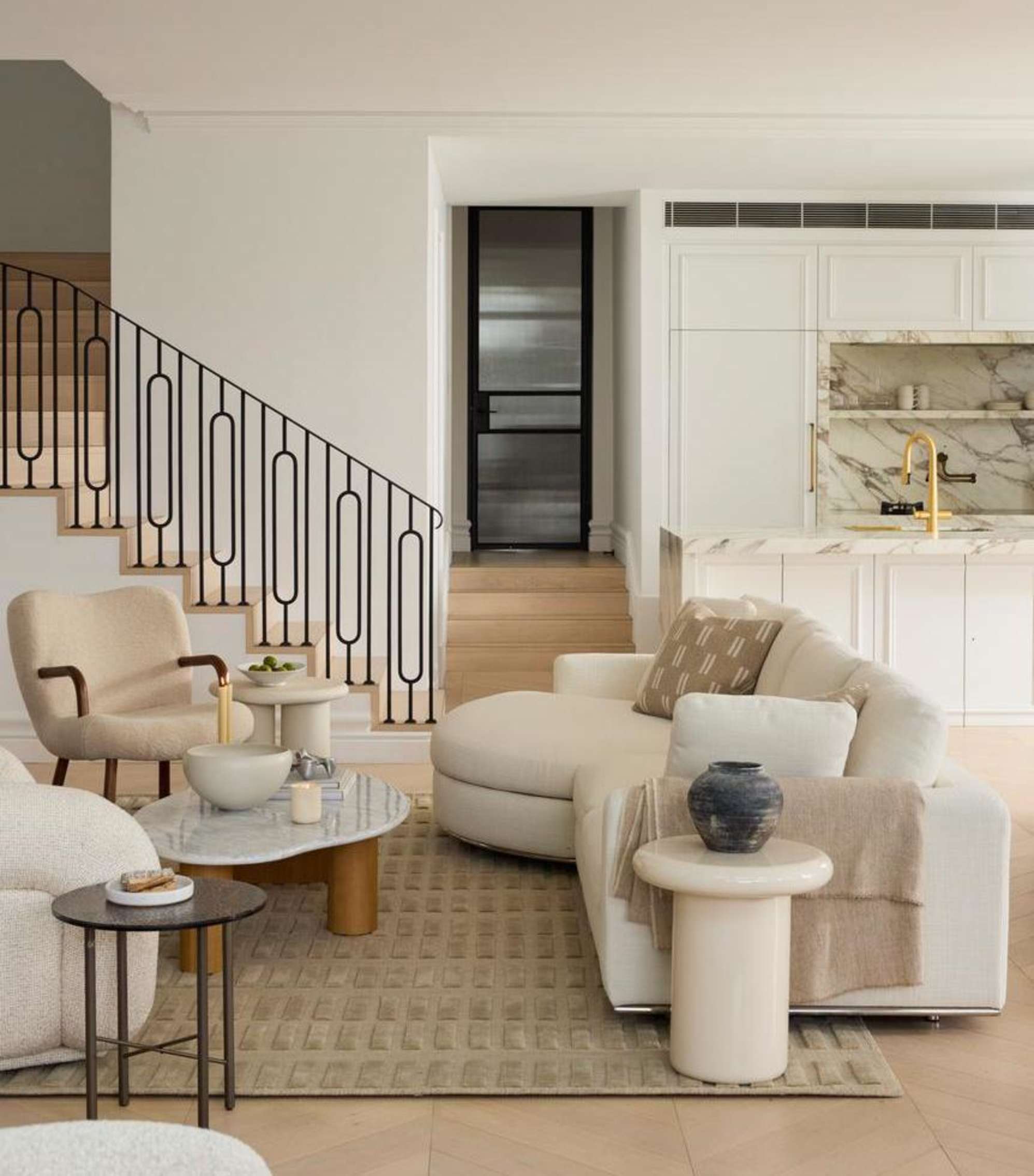
Pair materials with shapes to amplify the effect
Lines don't exist in isolation. Materials reinforce them.
Steel, oak, and marble naturally emphasise clean, crisp edges, while upholstered furniture, woven textures, and rounded stone surfaces soften those same forms.
Imagine a rectangular dining table with slim timber legs. On its own, it feels refined and architectural. Pair it with curved dining chairs, however, and the contrast suddenly makes both pieces feel more intentional.
The same principle works in living rooms. A linear media console becomes more interesting beside a rounded lounge chair, while bouclé upholstery can soften a structured frame without changing the furniture's silhouette.
Sometimes texture creates the balance your room needs before shape even enters the picture.
Let your home's architecture set the rhythm
The most convincing design schemes don't fight the architecture. They work with it.
If your home already features arches, rounded niches, or a curved staircase, you've been given a head start. Those architectural details naturally establish a softer rhythm throughout the space.
If not, there's no need to renovate. Instead, think of your walls, floors, and ceilings as the room's grid. Furniture and décor simply become opportunities to interrupt that grid with intention. An arched mirror, a curved table lamp, or a circular rug can introduce enough softness without competing against the architecture itself.
When every surface becomes curved, the effect quickly loses its impact. Your eye needs structure before it can appreciate contrast.


Common mistakes when mixing interior design lines
Knowing the principle is one thing. Applying it well is another. Here are three mistakes worth avoiding:
Buying without an overall vision: Decide whether your room should feel mostly structured or mostly soft before shopping. Otherwise, every new piece starts competing for attention.
Trying to achieve a perfect fifty-fifty balance: Balance isn't about equal numbers. A predominantly linear room with two thoughtfully placed curves often feels more cohesive than an exact split.
Ignoring smaller details: Furniture isn't the only place where lines appear. Mirrors, lighting, and rugs all contribute to the room's geometry, sometimes more than you realise.
Create a room that feels balanced, not predictable
The most memorable interiors don't rely entirely on straight lines or curved shapes. They understand when each deserves the spotlight. That's what gives a room rhythm, personality, and the kind of balance that feels effortless rather than carefully calculated.
When you're choosing your largest furniture pieces, think beyond colour or material. Consider the silhouette they'll introduce into the room because every other decision will build from there. Whether you're drawn to softly curved sofas or clean-lined modular designs, starting with the right shape makes it far easier to create a home that feels cohesive from every angle.

Frequently asked questions about curved lines in interior design
What do curved lines mean in interior design?
In a room, curved lines read as relaxed and informal. They signal a space meant to be lived in rather than looked at, which is why a single rounded piece can make a formal room feel suddenly approachable.
How are curved lines used in design?
The reliable method is one anchor and a few echoes. Pick a single curved statement, a sofa, an arch, a round dining table, then repeat the shape quietly in smaller pieces, like a mirror or a light fitting. Odd numbers tend to work better than pairs, and the curves should always sit against a mostly straight backdrop, since on their own they lose the contrast that makes them register.
What does a curved line indicate?
In design terms, a curved line indicates movement. Where a straight line reads as fixed and orderly, a curve suggests motion and an organic, hand-made quality, even in a piece that never moves. It makes a difference between a room that stands to attention and one that looks like it can breathe.
